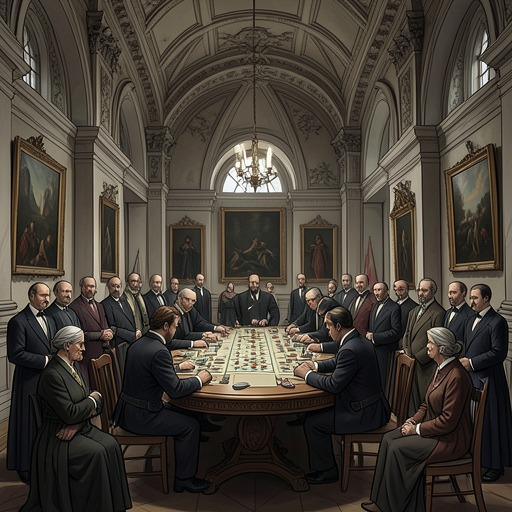
Bastian Perrot of Calw
The Glass Bead GameBastian Perrot of Calw is presented as the eccentric, sociable, and humane musicologist who gave the Glass Bead Game its first material form: colored glass beads strung on wires to represent musical notation. The apparatus began as a practical aid to musical memory and improvisation, but its name endured long after its beads disappeared and its purpose expanded into a universal language for relating the arts and sciences. Perrot’s invented biography also participates in the novel’s comedy, blending scholarly solemnity with concealed autobiographical and onomastic jokes.
Identity and Background
Perrot is described as clever and eccentric, with a strong attachment to music and handicraft. He is credited with a treatise on the apogee and decline of counterpoint, and is said probably to have belonged to the League of Journeyers to the East. His scholarly interests were unusually physical and practical: he built pianos and clavichords in old styles, and legend attributed to him a manner of violin playing obsolete since 1800, using a high-arched bow whose hair tension was regulated by hand.
The name itself is part of the novel’s play with biography. The historical-looking inventor is named after Heinrich Perrot, the owner of a machine shop where Hermann Hesse worked for a year after leaving school. The account’s grave tone thus conceals a personal reference, making Perrot at once a figure in the Game’s imagined history and an instance of the private jokes embedded in that history.
The First Glass Bead Apparatus
At the Cologne Seminary, pupils already played a musical exercise: one student called out a motif or the opening bars of a classical composition in standardized shorthand, and another supplied its continuation, a higher or lower voice, or a contrasting theme. It trained memory and improvisation, and recalled the practical counterpoint exercises of earlier musicians, performed on instruments or with the voice rather than in theoretical formulas.
Perrot adapted this exercise by building a frame like a child’s abacus, with several dozen wires. The wires corresponded to the lines of a musical staff; beads of different sizes, shapes, and colors represented musical values. By arranging them, players could set down quotations or invented themes, transpose and alter them, develop them, and place them in counterpoint. The device was technically a plaything, but students liked it, copied it, and helped make the exercise fashionable in England as well as Germany.
Perrot’s role was therefore an origin point, not the designer of the Game in its later, mature form. The bead-strung wires were an incidental and temporary means of playing musical exercises. Yet that contingent device supplied the enduring name: the later Game retained the title even after it had long ceased to have anything to do with glass beads.
From Musical Exercise to Universal Language
The early Game was a witty private exercise for developing memory and ingenuity, played by individuals or groups. A few especially successful Games were written down and circulated for admiration or criticism, but the practice was not yet a public ceremony. Within two or three decades, its popularity among music students waned and mathematicians took it up. Thereafter, different fields successively elaborated the Game, especially when a discipline was undergoing a period of flourishing or renewal.
In its developed form, the Game could begin from a musical theme, an astronomical configuration, a philosophical sentence, or a passage from the Upanishads. Players used symbols to establish relations among such materials, then varied, developed, and combined them, often according to musical or mathematical rules. Its long alliance with music remained important: themes could be elaborated in ways compared to a Bach fugue or concerto movement, while expert players could bring ideas from separate domains into intricate combinations.
The Game’s practitioners also used it to set opposing ideas beside one another, develop them with equal impartiality, and seek a synthesis. At its height, it became an elite symbolic practice directed toward perfection and unity, drawing nourishment from the arts and sciences and aspiring to move from becoming toward being. This later ambition is far removed from Perrot’s bead frame, but the origin story preserves the link between material musical play and the abstract cultural system that grew from it.
Narrative Significance
Perrot’s story gives the Glass Bead Game a deliberately modest beginning. A student pastime, an improvised apparatus, and an incidental name precede the ceremonial institution’s universal claims. That gap between humble mechanism and exalted purpose is part of the book’s historical and comic perspective: the Game’s prestige rests on a succession of transformations, not on a timeless design fully present at its invention.
The account also places Perrot within the novel’s broader onomastic comedy. His name quietly recalls Hesse’s own experience in a machine shop, just as the scholarly apparatus around the Game mixes invented authority with traces of real cultural history. Perrot’s enduring importance lies less in his personal development—he remains a figure from the Game’s reconstructed past—than in the contrast his invention establishes: beads vanish, the name survives, and a clever exercise becomes a vast language of intellectual aspiration.